Sunday afternoon was spent exploring more of Aspen on foot, including a nearby park and walking trails. The conference kicked off that night with a reception, followed by the start of the program on Monday morning. Here are some highlights from the first two days.
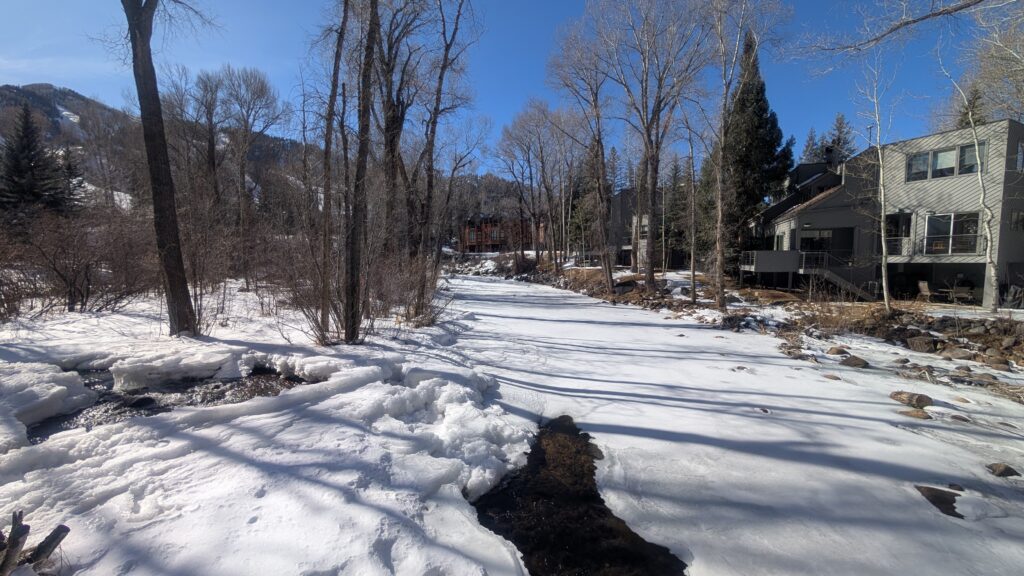
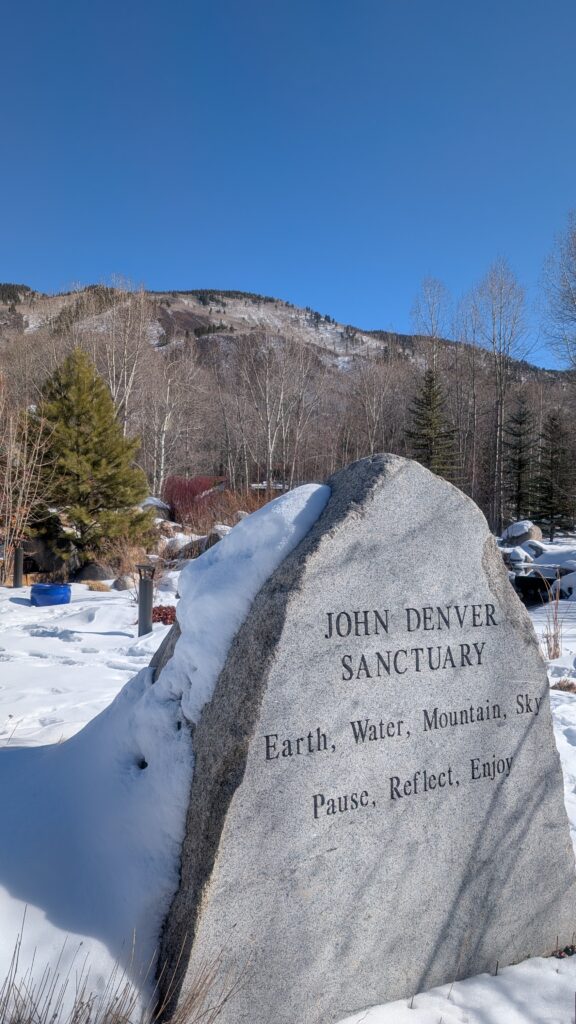
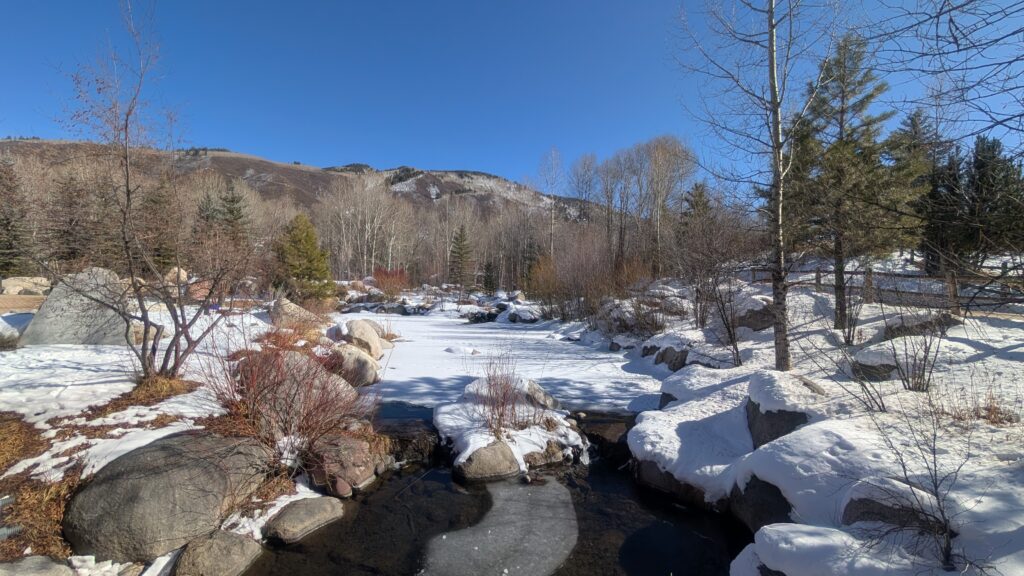
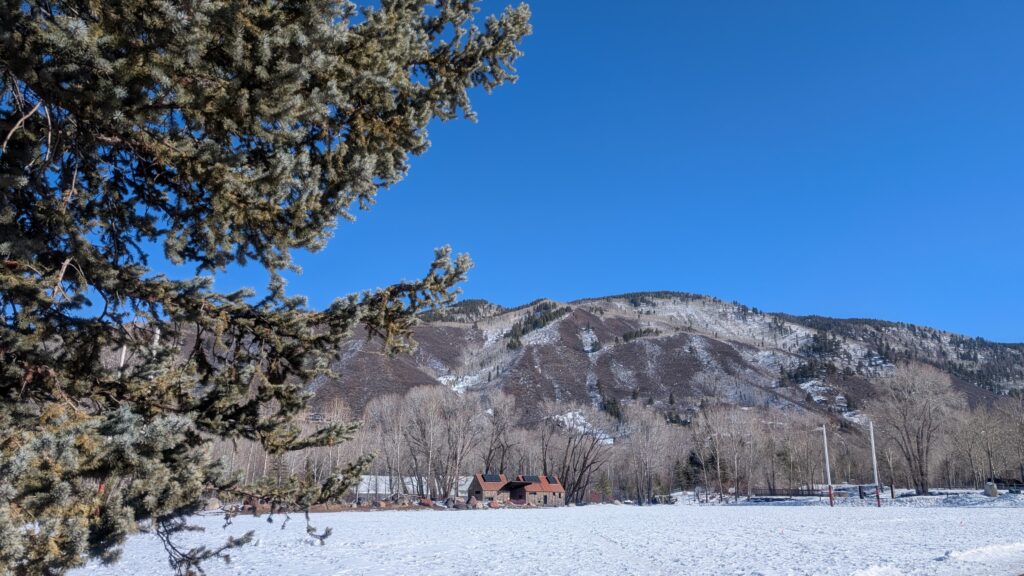
I spent time on Sunday walking around Aspen some more, working on my talk and funding proposal drafts, and checking out a very nice bookstore and cafe near downtown. It was a beautiful day to wander and get some exercise. I did a little exploring closer to the outskirts of the busy downtown area. In particular, I wandered into the John Denver Sanctuary and followed some of the trails through the woods and neighbourhoods.
Sunday evening saw the kickoff of the Aspen Center for Physics (ACP) program with a nice reception. There, I ran into some of the people I knew from my time as a collider physicist, who are here to present their work and/or results from their collaborations. I have not seen most of these folks since I left Dallas for Sudbury in 2022, and it was good to learn how they are doing, what they’re up to (and what’s got their attention these days), and share a little of how things have been since making the leap from collider to astroparticle physics.
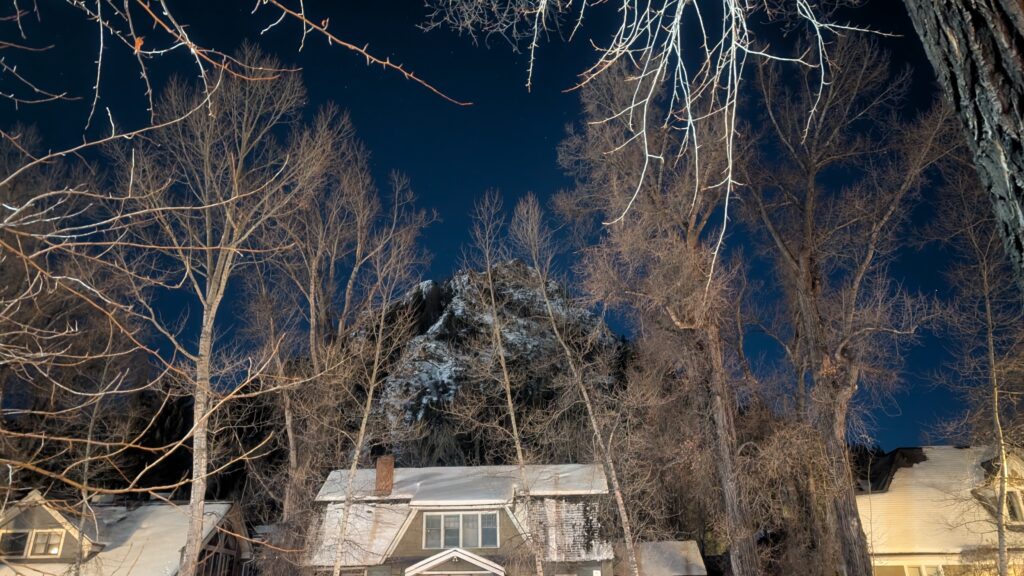
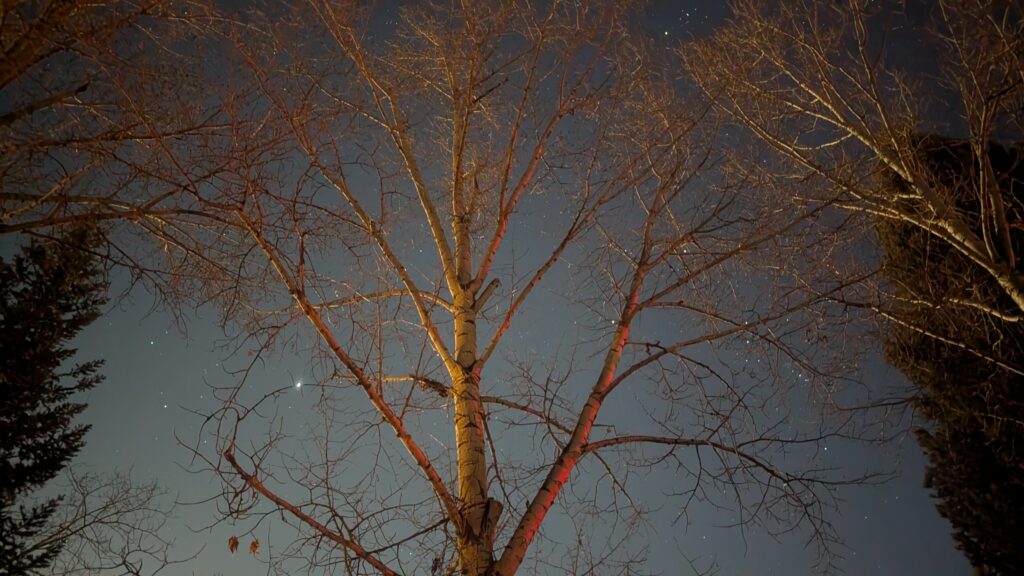
Walking back to the hotel that night, I finally got a look at the night sky over Aspen. It did not disappoint, even with the modest light pollution from the city!
Start of the Conference: “Paving the Way to New Discoveries in Particle Physics”
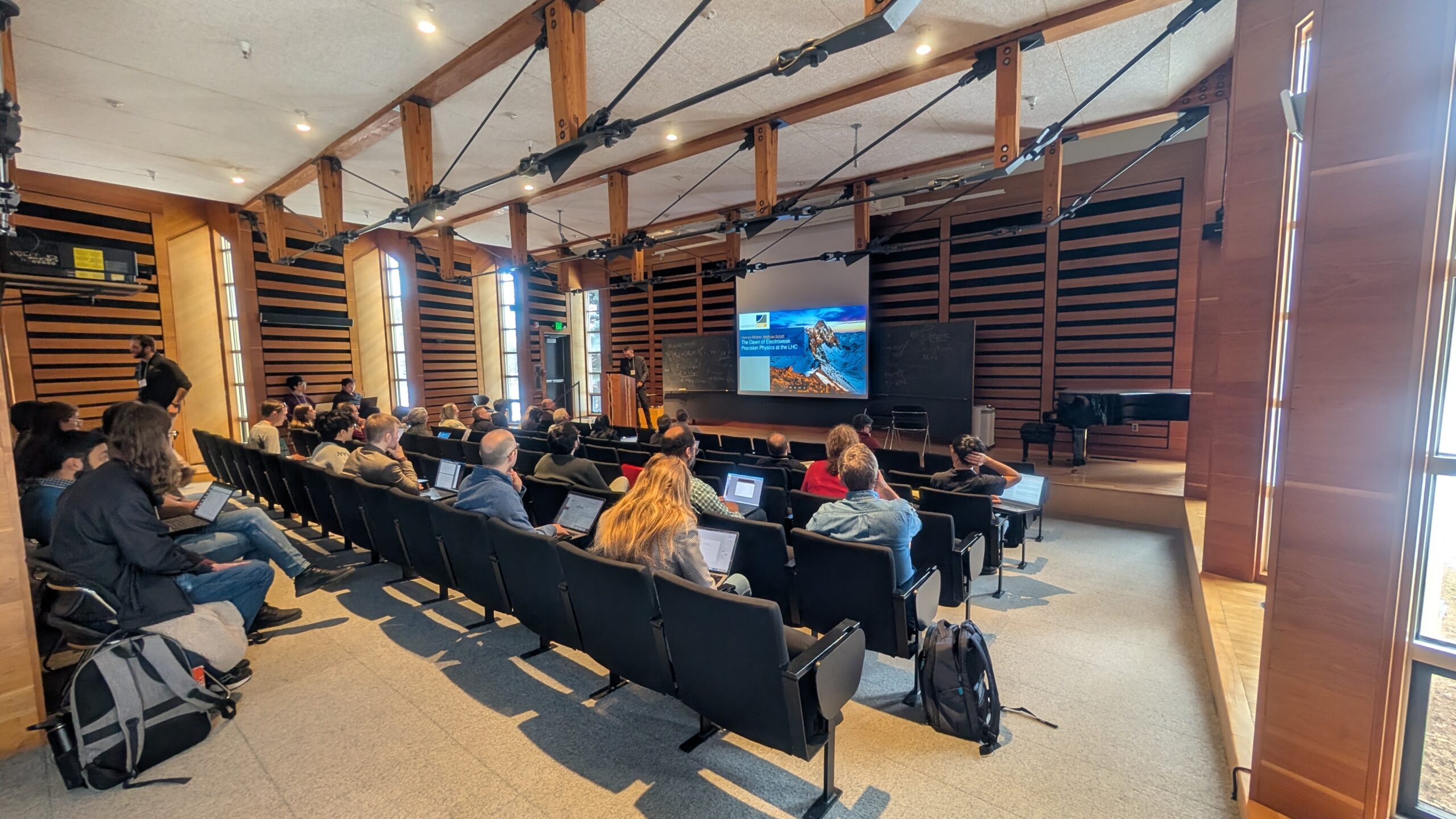
The conference program 1https://indico.cern.ch/event/1562147/timetable/#all.detailed began in earnest on Monday morning. The structure of each day is an 8am start with three talks and discussion, then a break, then three more talks and discussion. The conference pauses at 11am, giving people free time to ski, or work in the offices at the Center, or head off site to socialize elsewhere. People are using the time to do all of the above, including groups of younger participants who have been gathering in some of the public spaces at ACP to have discussions.
The program resumes in the afternoon at 4:30pm with the same structure as the morning: three talks, a break, and three more talks. We wrap up around 7pm, and resume again the next morning.
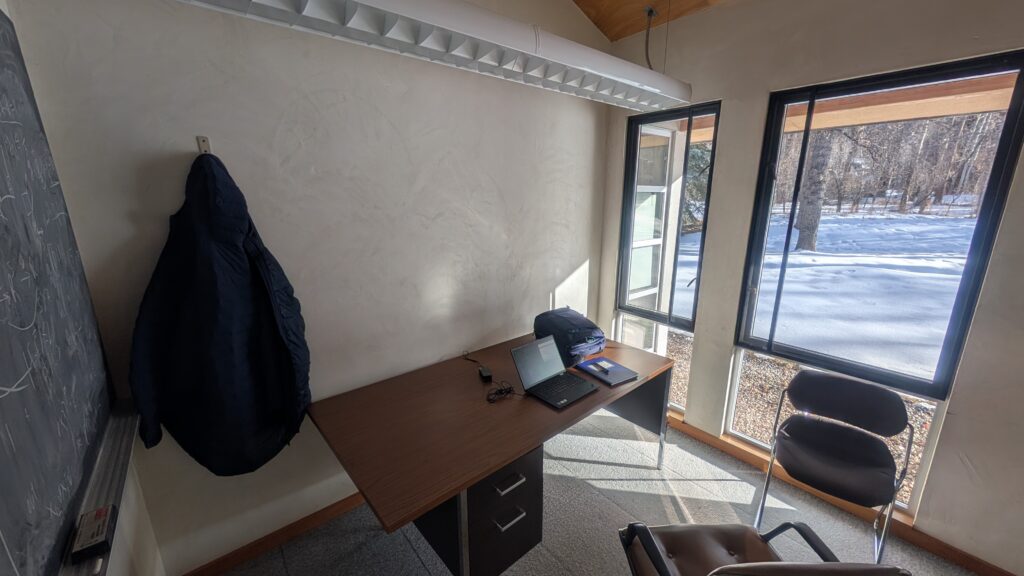
I have been taking advantage of time with colleagues to chat about ideas, ask them questions about material they presented, and for just catching up or suggesting scientific visits to SNOLAB. I have also been making use of the first-come, first-served office space at ACP. I like the office in the photo above; it’s almost always available, and it’s got a nice balance of light and dark and a little view. I need to make use of the blackboard more!
Some early highlights
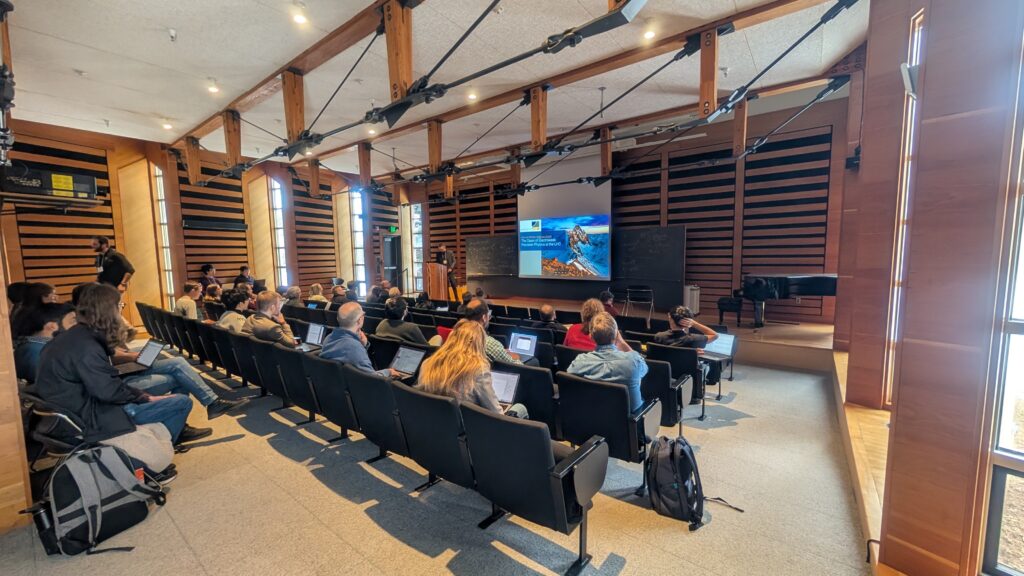
The primary focus of the first couple of days, so far, has been science from the Large Hadron Collider. This has included at least one talk exploring the European Strategy for CERN, which by consensus now involves planning for a 50km circumference Future Circular Collider (beginning as an electron-positron collider to serve as a “Higgs factory”, with an upgrade path to an even-more-future hadron collider). There was also a very nice presentation of the status of the Electron-Ion Collider, which I worked on from 2020-2022 (and had a LOT of fun doing so).
We’ve had one astrophysics talk so far, on gravitational wave observatories. It is exciting to see the sensitivity that the ground based laser interferometers are achieving, and with science running campaigns still to come the expectation is the detection of a lot more merging objects: black hole pairs, neutron star pairs (only one has been seen definitively so far, and the second one happened while observatories were offline so the sky-pointing was poor, preventing astronomical follow-up), and black-hole-neutron star mergers.
I would say that the highlights from the LHC can be summarized as follows, based on what has been presented so far:
- The experiments – ATLAS, CMS, and LHCb – continue to take data as they head into the last year of Run 3. Their total combined data sets mean these experiments have entered the era of “attobarn” science … having sufficient data to probe ultra-rare processes with rates in nature at unprecedented small levels. The era of high-precision LHC physics is not only imminent, it’s basically here.
- The quality of the measurement of Higgs particle properties, like mass, decay rates to various particles, and coupling to those particles, also exceeds expectations even from just a few years ago. In particular, machine learning using transformer algorithms has revolutionized (AGAIN!) the ability to determine the properties of particle jets more cleanly and precisely. This has enabled a number of challenging measurements thought pointless even 5 years ago.
- The same is true for measurement of top quark, Z boson, and W boson properties. Together, the “Big 4” of the Standard Model now have unprecedented constraints placed on them by experiment. This is beginning to challenge the precision of theory calculations, earlier than anticipated.
- If one combines all of these measurements in an Electroweak Fit – that is, asking the Standard Model to predict the value of parameter X when using information from all OTHER parameters EXCEPT X – one finds that the predictions match well the observations. The only parameter of the Standard Model where making more measurements might reveal deviations from the Standard Model, outside of uncertainties, is in the Weinberg (or “Weak”) mixing angle.
- There are still no direct signs of physics that is incompatible with the Standard Model. There are still more places one can look, but the real question now seems to be: if we take the totality of our observation and run those through an effective quantum field theory framework, at what energy scale(s) does the constrained framework predict new physics would have to appear and NOT mess up what we see already? This might help point the way toward the directions of an FCC program, beyond just being a “Higgs Factory”.
As the program continues, we will explore other subjects besides collider physics. But it’s clear that this subject dominates right now.
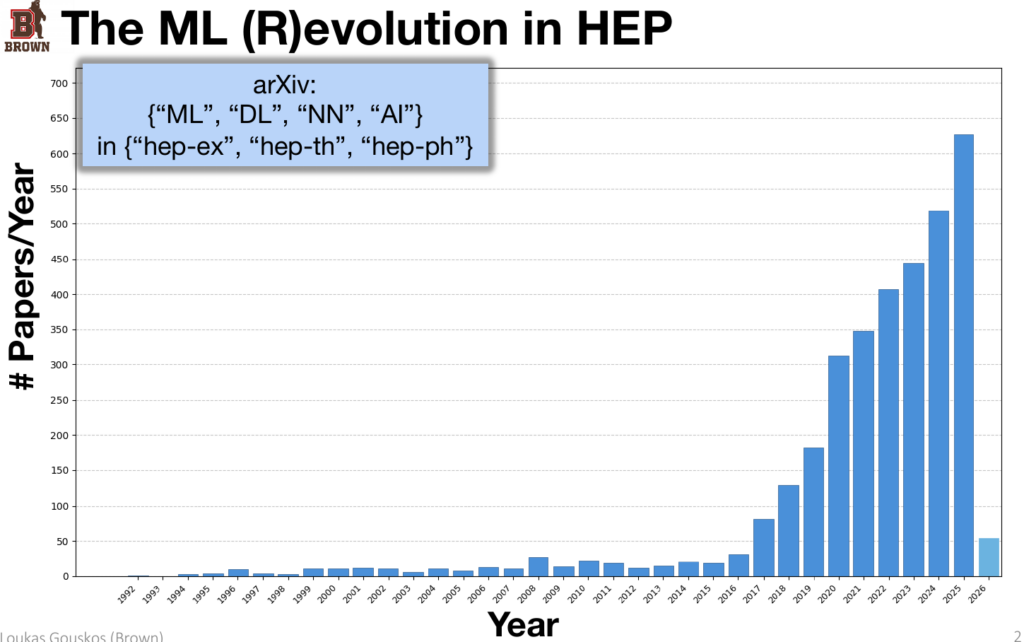
I will close by showing a really nice figure, presented by Loukas Gouskos, on the growth of machine learning and, eventually, artificial intelligence algorithms, in high-energy physics. The modern era of deep learning, transformers, and other advanced configurations or concepts has rocketed this subject to a forefront location.