
Several years ago, I was invited by a colleague of mine to join in an effort to teach a brief summer course entitled “The Secret City”. The few-day course, taught at a satellite university campus in New Mexico, explored the story of the Manhattan Project and its aftermath. It was a chance to engage a generalist audience of devoted participants in some nuclear and particle physics, a tour of Los Alamos, and some history.
Preparing for this course was my first formal dive into the American, Canadian, and European histories tied to the outbreak and resolution of World War II. It deepened my interest in the life of J. Robert Oppenheimer and expanded my interest in the “war lives” of other scientists. My lens for World War II has had two focuses. The first is the war as seen through the lives of physicists who lived through it. The second was the memoirs of my maternal grandfather, who fought in WWII.
History may not repeat, but it certainly rhymes. That saying, as written, is most accurately attributed to psychoanalyst Theodor Reik in 1965. I have been exploring the rhyming of history by referencing the history of WWII. The period of global turmoil just preceding the outbreak of war, and the actions undertaken by Nazi Germany that ultimately trigger the war, have a certain easy rhyming scheme with current geopolitical events.
I have been reflecting especially on some passages from David C. Cassidy’s “Beyond Uncertainty: Heisenberg, Quantum Physics, and the Bomb”. I reproduce a few snippets here that help this audience to engage in what has been troubling me of late.
” … local party and political officials, spurred on by the network of state and party organizations, had little trouble inciting mobs in every city and town across the Reich into a bestial frenzy against Jews and Jewish property during the night of November 9-10, 1938 … That terrible night came to be known as the Kristallnacht, or the night of broken glass, for the tons of shop-window glass that littered every German street the following morning. Finally, the Nazi regime had revealed in unmistakable terms to the world and to its own citizenry its true nature.” (David Cassidy, “Beyond Uncertainty”, pg. 285)
“A visibly shaken Heisenberg wrote to his mother on November 12 that he and Elisabeth were ‘still completely in shock from the last nights.’ … Worst of all, a friend had told them of a horrible scene on the morning of November 10 as entire Jewish families were dragged, screaming, to the train station, shoved onto passenger trains, and expelled from Germany.” (David Cassidy, “Beyond Uncertainty”, pg. 285)
“After successfully annexing Austria, Hitler had his sights set on the Sudetanland, a Germanic territory in Czechoslovakia that was now nearly surrounded by the new German Reich. As tensions mounted in September [1938], active military units, including Heisenberg’s, were placed on full alert … Heisenberg was sure of an impending invasion and certain that, because of the alliance arrayed against German expansion, this attack would touch off a second world war … Fortunately for Heisenberg, war was narrowly averted at the end of September by the infamous Munich treaty entered into by Hitler and Czechoslovakia’s allies, Italy, France, and England … It was the last appeasement Hitler would receive.” (David Cassidy, “Beyond Uncertainty”, pg. 281)
“I want to say that the settlement of the Czechoslovakian problem, which has now been achieved is, in my view, only the prelude to a larger settlement in which all Europe may find peace. This morning I had another talk with the German Chancellor, Herr Hitler, and here is the paper which bears his name upon it as well as mine. Some of you, perhaps, have already heard what it contains but I would just like to read it to you, ‘We, the German Fuhrer and Chancellor, and the British Prime Minister, have had a further meeting today and are agreed in recognizing that the question of Anglo-German relations is of the first importance for the two countries and for Europe.
‘We regard the agreement signed last night and the Anglo-German naval agreement as symbolic of the desire of our two peoples never to go to war with one another again.
We are resolved that the method of consultation shall be the method adopted to deal with any other questions that may concern our two countries and we are determined to continue our efforts to remove possible sources of difference and thus to contribute to assure the peace of Europe.’ (Prime Minister Neville Chamberlain, September 1938, speaking after landing at the Heston Aerodrome upon returning from Munich)“My good friends, this is the second time in our history that there has come back from Germany to Downing Street peace with honour. I believe it is peace for our time. We thank you from the bottom of our hearts. And now I recommend you to go home and sleep quietly in your beds.” (Prime Minister Nevill Chamberlain, speaking from 10 Downing Street later that same day)
Final Note
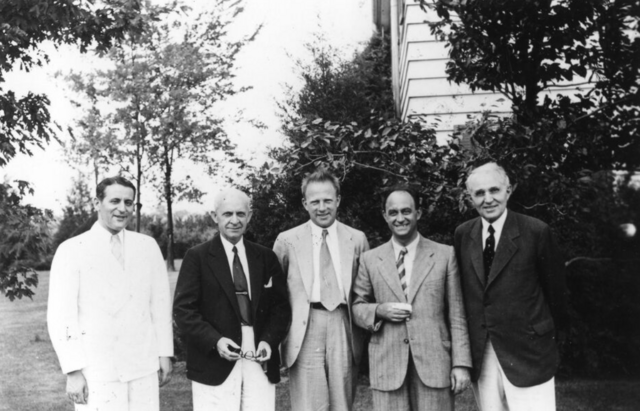
The photo accompanying this post is licensed under Creative Commons and originates from the Emilio Segre archives. It depicts a moment at the 1939 summer school in Michigan. The photo features Dutch-American physicist Samuel Goudsmit, Werner Heisenberg, and Italian physicist Enrico Fermi. Within months of this photo, Germany invaded Poland and England formally declared war on Germany. Goudsmit’s parents died in a concentration camp, murdered by the Germans in 1943. Enrico Fermi had already fled the fascist regime in Italy owing to anti-Jewish laws that targeted his wife.