I don’t ski. I don’t want to ski. So why am I in Aspen, Colorado for the next week? I am here because Aspen is home to one of the great centers for physics.
Yeah, I don’t ski
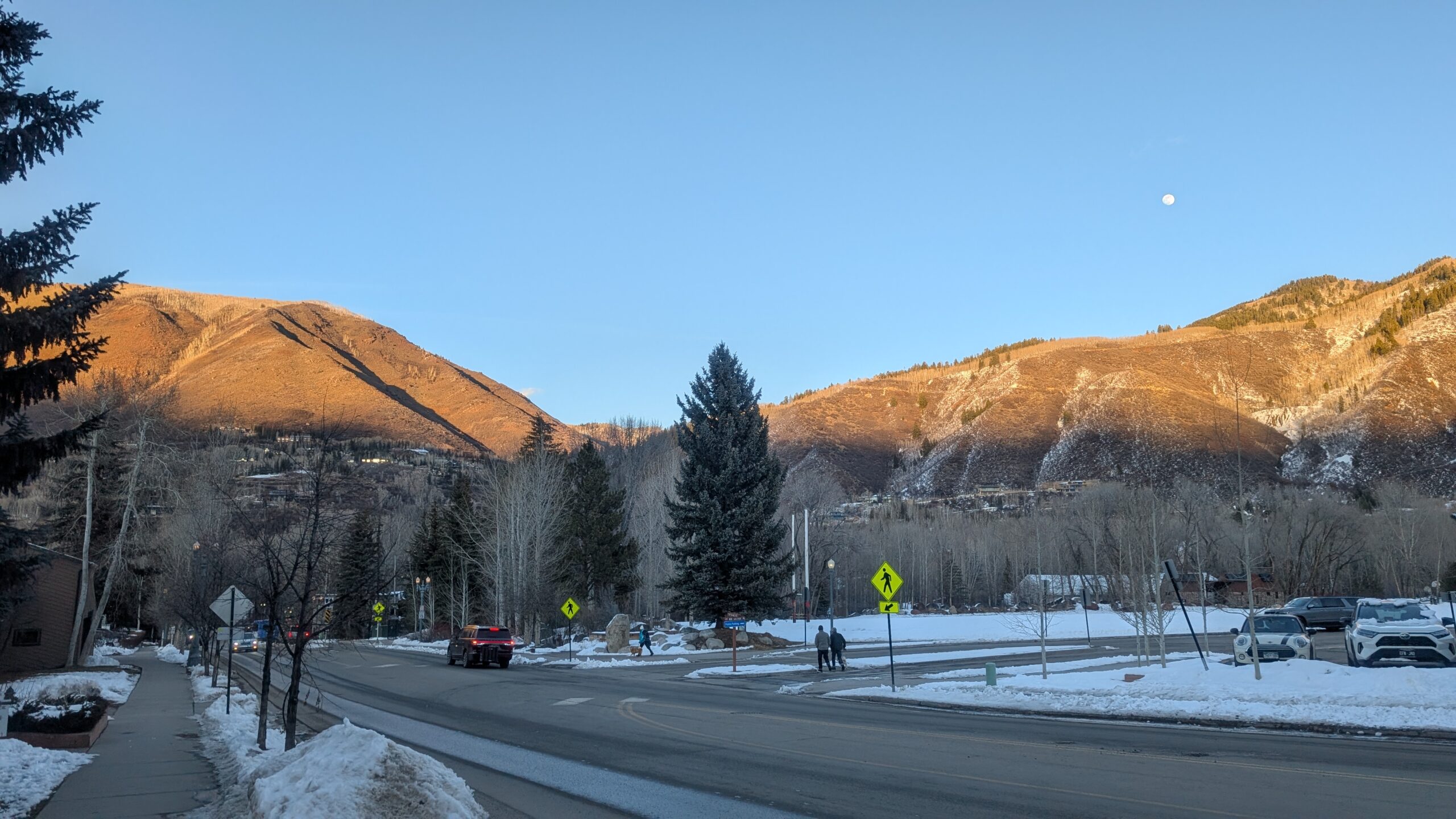
I arrived in Aspen in the mid-afternoon yesterday. At 2.4km (7900 ft) above sea level, this is the highest altitude I have visited since 2022 when I was last in Taos, NM, USA, at 2.1km (7000 ft). I seem to be managing the altitude issues (less oxygen) well, for the most part.
The draw of Aspen is very clearly skiing. It’s coded into the DNA of the place. The public buses have exterior ski racks. Ski poles litter the floor of the bus as skiers come back from or head out to the powder. The conversations on the bus are a blur of New York and other transplant accents. People talk altitude, ski conditions, drinks and restaurants, and whose spouse will or won’t be joining them for all of it.
I don’t ski. I abhor the idea of skiing. Me and gravity have a checkered history. In the last year, I have fallen twice: once when trying to learn to ice skate (two falls, with serious bruising to my hip and forearm) and once in a freshly washed shower at a hotel.1Turns out the cleaning product, mixed with water, makes for a very slippery surface. I bruised an elbow and a hip.. There is no way in hell I am going on skis on a mountain, and don’t lecture me about padding and gear and how soft proper powder is.
So why the hell am I here? I am here because of the Aspen Center for Physics2More information about the Aspen Center for Physics: https://aspenphys.org/. Specifically, I am here for one of their winter conferences, “Paving the Way to New Discoveries in Particle Physics”3https://indico.cern.ch/event/1562147/timetable/#all.detailed.
Places to go and think
I have always wanted to retreat at a monastery for a period of time so that I can engage in quiet, undisturbed reflection on a subject. Not religion, mind you, though I would welcome intelligent conversations about religious thinking. Monasteries are a romantic ideal for me, one where you are isolated from the distractions of the everyday world; one where you are offered a simple place to sleep and read; one where you are allowed a focus on one’s relationship with the cosmos (religious, scientific, or otherwise).
Hanging out in a monastery is generally not practical. But science has other such places.
The Aspen Center is one of them. I have longed to visit it for the purpose of engaging with other physicists in discussions, lectures, and sharing. I have a fondness for places outside of the normal workplace where scientists intentionally gather and learn from one another. An academic department or a research laboratory becomes an echo chamber. They tend to become places that are deeply obsessed with themselves and the preservation of that self. One easily forgets there is more to do than paperwork, and reports, and budgets, and policies, and training, and meetings.
Oh God, the meetings.
The Kavli Institute for Theoretical Physics at University of California Santa Barbara is one such place where one can escape the echo chamber. I had the great fortune of visiting in 2018 (as a spouse of a physicist, but not at the invitation of anyone at KITP … and only briefly, over one long weekend). Being there had a transformative effect on my thinking about spaces for idea development. One needs housing, so scientists don’t have to think about renting a roof and four walls. One needs space to house families, so there is no separation anxiety. One needs ease of access to groceries and restaurants. One needs a blackboard or whiteboard on every conceivable surface. One needs lunch provided by the institution, so people don’t waste time finding restaurants but instead focus on gathering and talking. One needs good scenery and things to do outside the space, because distraction is important to discovery.
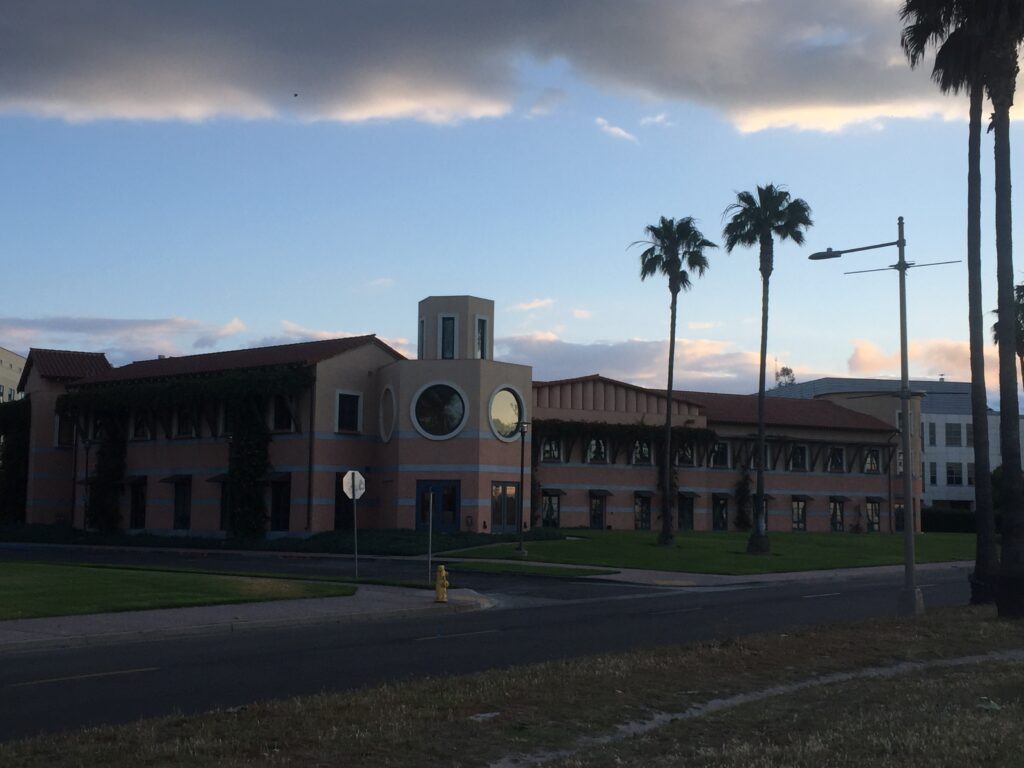
There are many other such places in the world: the Les Houches school in the mountains east of Geneva, Switzerland; the Moriond Conferences; the TASI summer school; the Perimeter Institute; the Institute for Advanced Study; the Snowmass meetings (now no longer held in Snowmass, Colorado). These are all legendary within the particle physics community for places one goes to get away from the routine, dive into new ideas (drown in them, usually), and emerge either knowing more about physics or knowing more people to collaborate with on physics.
The misconception of where you should do science
When I mentioned to people at work that I was going to a conference in Aspen, their instinct was to note the skiing. They would check out the conference schedule and then go out of their way to note how much time is allocated during the week for skiing. There is this sense by many, including many public funding agencies, that going to these places is somehow more a vacation than a science meeting. In the US, there was a backlash against holding the Snowmass meetings in the actual village of Snowmass (after which the meetings are named!), because of the perception that it was “just a ski vacation for physicists”.
I understand where these criticisms come from. People look for things they deem “wasteful” and then organize against them like a religious movement. I would argue that little is actually saved and much is actually lost from that approach.4A very good operating principle for civil engagement is one I learned when advocating for things in Washingont, D.C.: if all you do is argue against someone else, you’ve failed to ever say anything good about yourself.[.mfn]
One need look no further than the Manhattan Project to see why.
The secret city and its benefits
The Manhattan Project should have been a permanent blueprint for how to organize a bunch of isolated scientists and engineers to get them to work toward a common goal. The leaders of the project – General Leslie Groves (the military director) and Dr. J. Robert Oppenheimer (the scientific director) – disagreed on a lot of things. But, early on they realized the value of bringing people together in one place, with satellite locations focused on very specific and challenging tasks. Los Alamos was selected for at least two reasons: its isolation (a benefit to secrecy, which mattered in a secret war project) and its familiarity to Oppenheimer, who came of age in the mountains of New Mexico not far from Los Alamos.
Groves’s instinct (and that of his security officers) was too isolationist. Bring the scientists but not their families. Lock the scientists down on the site until the work was done, with few or no off-site excursions. Compartmentalize the organization so scientists only knew what they were working on and not how it connected to anything else.
Oppenheimer recognized early on this is not how you motivate thinkers to think. Let them have their families, and employ spouses (mostly women at the time) in roles at the lab. The stress of family separation is relieved. Allow scientists passes to go off-site and enjoy the pleasures of living, for at least two reasons: so they can blow off steam and so they can be reminded of what they are working to defend. Let scientists work across groups, to enhance the chance that a problem in one area could be solved by thinking in another.
The effect of this was, of course, well known: a practical atomic bomb was developed, and in relatively short order despite the engineering challenges and physical science problems. This model could then be applied to any complex project, any complicated problem. In this case, a secret city was created to protect a secret, but it did not prevent its residents from having enough taste of the world outside. This balance enabled people to survive a very stressful war project.
The US government has largely forgotten the lesson it helped to teach the world. Snowmass is no longer in Snowmass because it’s too “resort-like”. Snowmass instead moves around to various urban centers. Rather than isolating physicists in one place for many weeks at a time, people only gather for one week every 10 years and otherwise work in small, isolated groups on Zoom. I find the whole thing mind-numbing and pointless these days, because there is no “there there”. There is no emphasis on the human connection critical to science, only on fiefdoms talking about their fiefdoms.
The path to pave
Aspen is a chance for me to see the opposite at work. Many people are coming from many places to focus on the theme for a week. We are “isolated” together in a single place, a center designed to facilitate such meetings. There is ample “skiing time” in the schedule, but I will be using that for side conversations with others who don’t ski or who ski a little and then are done with it. There should be plenty of those.
I am eager, after 3 years of co-authoring a textbook on hunting for dark matter, to catch up on the latest news in the field. I want to know the state of play of axion, and axion-like particle, searches. I want to know the state of collider- and telescope-based approaches to hunt for signs of dark matter “in there” (being produced in collisions) and “out there” (interacting in the wider cosmos). I want to see what crazy thinking people are resorting to in order to crack the problem of how to make new discoveries in a challenging world. I want to share information about how many laboratories are orienting themselves to host the collaborations of the future.
I want to learn. Isolated in the mountains, nearly as high above sea level as SNOLAB is below the ground, I will have no choice but to listen and talk. I will do so with many colleagues from across our disciplines and projects. There will be ample time to argue and discuss and talk about ideas. I believe I will learn a lot, and be able to share a lot with my community when I return to Canada.